
Introduction
One of the most important distinctions in the Christian doctrine of salvation is the difference between justification and sanctification. Although these doctrines are closely related, they do not mean the same thing. Confusing them can lead to serious misunderstandings about the gospel, the role of good works, and the believer’s assurance of salvation.
Some people mistakenly believe that Christians must perform enough good works to become righteous before God. Others emphasize salvation by grace in such a way that obedience and holiness appear unnecessary. Both errors fail to preserve the biblical relationship between God’s gracious work of saving sinners and His work of transforming them.
The Bible teaches that sinners are justified through faith in Jesus Christ, apart from their works, and that those whom God saves are also being sanctified by the Holy Spirit.
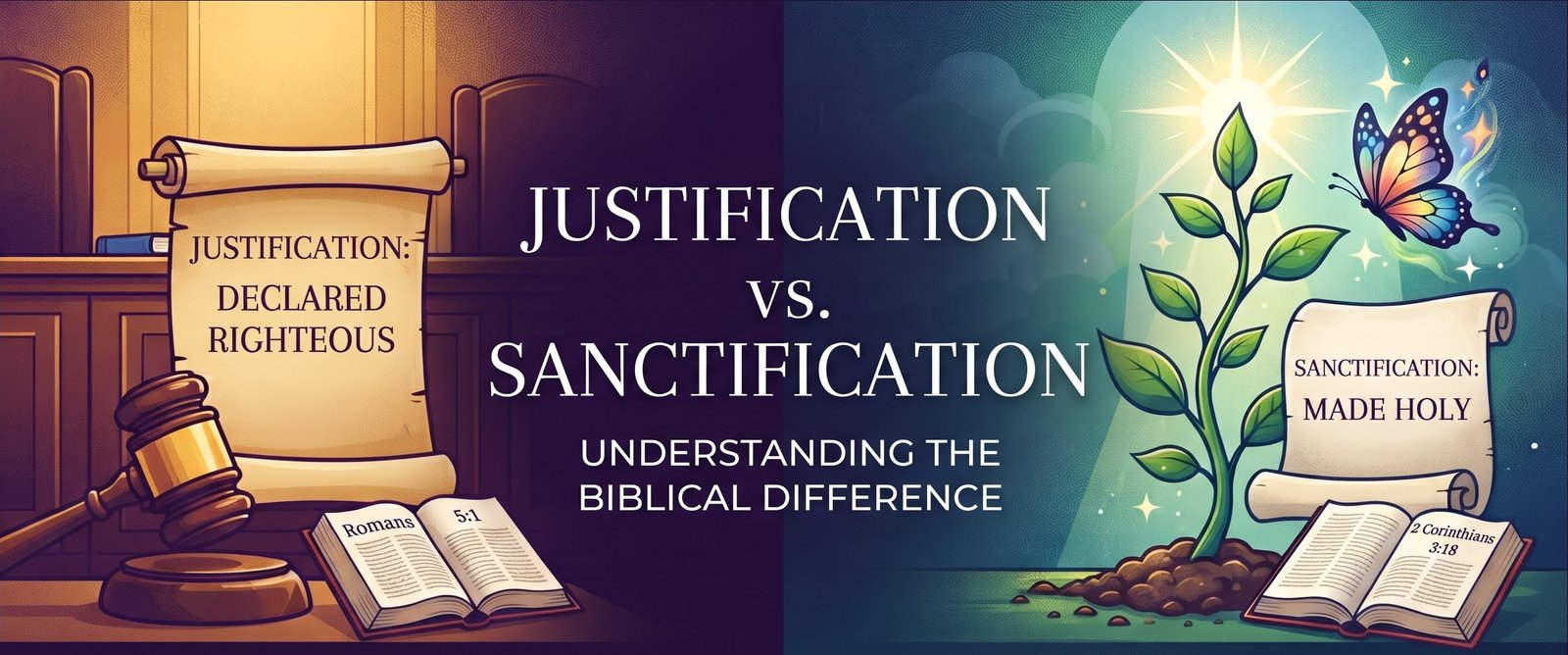
The central distinction is this: Justification changes our standing before God, while sanctification changes our lives.
Both are essential aspects of salvation, but they must never be confused.
1. What Is Justification?
Biblical Definition
Justification is God’s judicial declaration that a sinner is righteous in His sight, not because of the sinner’s personal goodness or works, but because of the righteousness of Jesus Christ received through faith alone.
Justification is a legal or forensic concept. It concerns our standing before God’s righteous judgment. God does not justify sinners because they have already become morally perfect. He justifies those who trust in Christ, whose righteousness is the ground of their acceptance before Him.
“Therefore we conclude that a man is justified by faith without the deeds of the law.”
— Romans 3:28 (KJV)
Paul teaches that justification is not earned through obedience to the law. No sinner can establish a claim to righteousness before God by presenting personal achievements, religious ceremonies, charitable acts, or moral accomplishments.
“But to him that worketh not, but believeth on him that justifieth the ungodly, his faith is counted for righteousness.”
— Romans 4:5 (KJV)
Notice Paul’s description: God justifies the ungodly. The person being justified does not first establish a record of sufficient good works and then receive God’s approval. Rather, the sinner rests in God’s provision of righteousness through Christ.
The Basis of Justification
The foundation of our justification is not the quality of our faith, the number of our good works, or the degree of our personal holiness. Its foundation is the saving work and righteousness of Jesus Christ.
“Therefore being justified by faith, we have peace with God through our Lord Jesus Christ.”
— Romans 5:1 (KJV)
In the Reformed understanding, Christ’s righteousness is credited, or imputed, to believers. His obedience and atoning sacrifice provide the righteous basis for their acceptance before God.
“For he hath made him to be sin for us, who knew no sin; that we might be made the righteousness of God in him.”
— 2 Corinthians 5:21 (KJV)
This does not mean Christ became morally sinful. He remained sinless while bearing the judgment due to His people. Through union with Christ, believers receive the benefits of His saving work, including justification.
The Instrument of Justification
Faith is the instrument by which we receive Christ and His righteousness. Faith does not earn justification; it rests upon Christ, who alone provides the righteousness we need.
“For by grace are ye saved through faith; and that not of yourselves: it is the gift of God: Not of works, lest any man should boast.”
— Ephesians 2:8–9 (KJV)
Therefore, justification is:
- By grace: It is God’s undeserved favor.
- Through faith: Faith receives Christ and His saving benefits.
- Grounded in Christ: His righteousness and atoning work are the basis of our acceptance.
- Apart from our works: Our obedience does not earn or merit our righteous standing before God.
Justification is God’s once-for-all judicial declaration. It is not a gradual process in which we become increasingly justified as we perform more good works.
2. What Is Sanctification?
Biblical Definition
Sanctification is God’s work of setting believers apart as His own and transforming them into the likeness of Jesus Christ through the work of the Holy Spirit.
Sanctification concerns holiness, spiritual growth, and the transformation of our lives. Unlike justification, which declares our righteous standing before God, progressive sanctification changes our attitudes, desires, conduct, and obedience.
“For this is the will of God, even your sanctification, that ye should abstain from fornication.”
— 1 Thessalonians 4:3 (KJV)
God does not save people merely to leave them living under the dominion of sin. He calls them to holiness and teaches them to live in obedience to His Word.
“But we all, with open face beholding as in a glass the glory of the Lord, are changed into the same image from glory to glory, even as by the Spirit of the Lord.”
— 2 Corinthians 3:18 (KJV)
Sanctification is the work of God’s Spirit in believers, producing genuine spiritual transformation. Christians are called to pursue holiness, put sin to death, grow in obedience, and cultivate the fruit of the Spirit.
The Relationship Between God’s Work and Our Effort
Although sanctification is God’s work, Christians are not commanded to remain passive. Philippians 2:12–13 teaches believers to work out their salvation because God is at work in them, enabling them to will and to act according to His good purpose.
This means that Christian obedience is neither an attempt to earn salvation nor an independent effort apart from God’s grace. Believers actively pursue holiness because God is already working in them.
Sanctification includes:
- Putting sinful desires and practices to death.
- Growing in love, humility, patience, and self-control.
- Obeying God’s Word.
- Repenting when we sin.
- Serving others in love.
- Becoming increasingly conformed to the character of Christ.
In the Reformed understanding, sanctification begins with God’s work of setting believers apart in Christ and continues throughout their earthly lives as they grow in holiness. This progressive growth will never reach sinless perfection in this life, although believers are called to pursue holiness sincerely and diligently.
3. The Main Differences Between Justification and Sanctification
Although both doctrines belong to the salvation God provides in Christ, they answer different questions:
| Justification | Sanctification |
|---|---|
| Concerns our standing before God. | Concerns our growth in holiness. |
| Is God’s judicial declaration of righteousness. | Is God’s work of setting us apart and transforming us. |
| Is grounded in Christ’s righteousness and atoning work. | Is accomplished through the Holy Spirit’s work in believers. |
| Is received through faith apart from works. | Produces obedience and good works as its fruit. |
| Is once for all, not a gradual process. | Begins with God’s setting us apart and continues progressively throughout our lives. |
| Answers: “How can a sinner be accepted as righteous before God?” | Answers: “How does a believer grow in holiness and Christlikeness?” |
Remember: Justification is not God’s declaration that we have already achieved moral perfection. Sanctification is not our attempt to earn the declaration of righteousness that only Christ can provide.
4. Why Must We Not Confuse These Two Doctrines?
Confusing justification and sanctification can lead to two opposite errors: legalism and antinomianism.
Error 1: Legalism — Treating Good Works as the Basis of Acceptance
Legalism occurs when a person treats human obedience, religious practices, or moral achievements as the ground of acceptance before God.
A legalistic understanding may suggest that Christ begins our salvation, but our good works must complete the basis of our justification. This undermines the sufficiency of Christ’s righteousness and the biblical teaching that justification is by faith apart from works (Romans 4:4–5).
If justification depended on our moral performance, no sinner could possess a secure basis for acceptance before God’s perfect holiness. Our works are imperfect, and we remain dependent upon Christ’s finished work.
Good works matter, but they are not the price we pay to become righteous before God.
Error 2: Antinomianism — Treating Grace as Permission to Sin
The opposite error is to argue that because salvation is by grace, holiness and obedience do not matter.
“What shall we say then? Shall we continue in sin, that grace may abound? God forbid.”
— Romans 6:1–2 (KJV)
Grace does not give believers permission to remain comfortable in sin. Those united to Christ are called to walk in newness of life. A person cannot rightly use justification by faith as an excuse to reject the very holiness God produces in those He saves.
The Christian does not obey God to purchase salvation. The Christian obeys God because salvation is God’s gracious work and the believer now belongs to Christ.
Summary:
• Legalism says good works are the root of acceptance before God.
• Antinomianism says good works do not matter.
• Scripture teaches that good works are the fruit of God’s saving grace.
5. What About James 2:24 — “Justified by Works”?
One of the most common objections to justification by faith alone comes from James 2:24:
“Ye see then how that by works a man is justified, and not by faith only.”
— James 2:24 (KJV)
At first glance, this may appear to contradict Paul’s teaching in Romans 3:28. However, we must interpret both passages in their contexts rather than assume that the apostles are teaching opposing gospels.
Paul’s Emphasis: How Is a Sinner Accepted Before God?
In Romans 3–4, Paul addresses the basis of a sinner’s righteous standing before God. He argues that justification is not earned through works but received through faith. Abraham is his example (Romans 4:3). Paul is rejecting human works as the basis or meritorious ground of justification.
James’s Emphasis: What Kind of Faith Is Genuine?
James addresses a different problem: a person claims to have faith but displays no corresponding obedience.
“Even so faith, if it hath not works, is dead, being alone.”
— James 2:17 (KJV)
James uses Abraham to demonstrate that genuine faith is evidenced by action. Abraham’s willingness to offer Isaac demonstrated the reality and maturity of his faith (James 2:21–23). His obedience did not purchase God’s favor; it demonstrated that his faith was genuine.
- Paul rejects works as the basis of justification; James rejects a claim to faith that produces no works.
- Paul explains how sinners are justified apart from works; James explains why genuine faith cannot remain fruitless.
Both apostles affirm that salvation is God’s gracious work and that genuine faith produces a life of obedience.
6. Are Good Works Necessary for Salvation?
This question requires a careful distinction:
- If we ask whether good works are the meritorious basis of justification, the biblical answer is no.
- If we ask whether good works are the necessary fruit of genuine saving faith, the biblical answer is yes.
Ephesians 2:8–10 provides one of the clearest explanations. Verses 8–9 teach that we are saved by grace through faith, not by works, so that no one can boast. Verse 10 then explains:
“For we are his workmanship, created in Christ Jesus unto good works, which God hath before ordained that we should walk in them.”
— Ephesians 2:10 (KJV)
Notice the order:
- We are saved by grace through faith.
- We are God’s workmanship in Christ.
- We are created in Christ for good works.
- We are called to walk in those good works.
Good works are not the cause or meritorious basis of our salvation. They are the intended fruit of God’s saving work. This distinction is essential. We must not reverse the biblical order and teach that we perform good works so that God will justify us. Neither should we deny the purpose of salvation by claiming that holiness and obedience are optional.
A useful Reformed summary is:
“We are justified by faith alone, but the faith that justifies is never alone.”
True faith rests in Christ and, through the Spirit’s work, produces repentance, love, obedience, and perseverance. These fruits do not replace Christ’s righteousness; they provide evidence of God’s transforming work in the believer.
7. Can a Christian Be Justified but Never Sanctified?
In the ordinary biblical understanding of salvation, justification and sanctification must be distinguished but never separated.
Romans 8:30 presents God’s saving purpose as an unbroken sequence: those whom He predestined He also called, justified, and glorified. First Corinthians 6:11 also describes believers as washed, sanctified, and justified in the name of the Lord Jesus and by the Spirit of God.
These passages show that salvation includes more than a change in legal standing. God also sets His people apart for Himself and works in them to produce holiness.
This does not mean that every Christian grows at the same pace or displays the same degree of maturity. Believers may struggle with serious sins, experience seasons of spiritual weakness, and require correction and discipline. Nor does sanctification mean that a Christian becomes sinlessly perfect during this earthly life.
However, Scripture does not present a person who has been truly saved as someone who can permanently reject Christ’s lordship, remain indifferent to sin, and have no concern for holiness. The presence of spiritual struggle does not automatically prove that faith is false. Yet a settled, unrepentant rejection of God’s Word should never be dismissed by appealing to grace.
The distinction is between imperfect growth and the complete absence of spiritual life. Genuine believers still need repentance, correction, and growth, but God’s saving grace does not leave them unchanged.
8. How Are Justification and Sanctification Connected to Christ?
Both justification and sanctification are benefits of salvation found in union with Jesus Christ.
Christ is not merely the example we imitate to improve ourselves. He is the Savior whose righteousness and sacrifice secure our acceptance before God, and He is the Lord whose Spirit transforms His people (Romans 5:1; Romans 6:4).
These truths must remain together. We cannot replace Christ’s righteousness with our own achievements, and we cannot claim to belong to Christ while treating His commands as irrelevant.
The Christian life does not proceed from self-righteousness toward acceptance with God. It proceeds from God’s grace in Christ toward a life of grateful obedience. Our obedience is not an attempt to complete Christ’s finished work; it is the fruit of belonging to Him.
9. Practical Application for Every Christian
Understanding these doctrines should shape our daily Christian lives:
- Rest in Christ rather than your personal achievements. When you recognize your sins and shortcomings, remember that your righteous standing before God rests upon Christ, not upon a record of perfect performance.
- Pursue holiness without treating it as a payment for salvation. Study God’s Word, resist temptation, repent of sin, and cultivate godly character because you belong to Christ.
- Do not use grace as an excuse for disobedience. The same gospel that frees us from condemnation also calls us to a new life under Christ’s lordship.
- Examine the fruit of your faith honestly. Good works do not earn God’s acceptance, but a persistent absence of repentance, love, and obedience should lead to serious self-examination in the light of Scripture.
- Give God the glory for both your salvation and your growth. Justification excludes boasting in our righteousness, while sanctification reminds us that spiritual growth depends upon God’s gracious work in us (Philippians 1:6).
Conclusion
Justification and sanctification are distinct but inseparable aspects of God’s saving work.
- Justification is God’s once-for-all judicial declaration that believers are righteous in His sight through faith in Jesus Christ, on the basis of Christ’s righteousness and atoning work.
- Sanctification is God’s work of setting believers apart for Himself and progressively transforming them into the likeness of Christ through the Holy Spirit.
We must never confuse these doctrines. Our good works do not earn justification, but genuine saving faith produces good works as its fruit. We do not become accepted by God through our personal holiness; rather, those whom God accepts in Christ are called and enabled to grow in holiness.
The gospel is not that sinners save themselves through moral improvement. It is that God saves sinners by grace through faith in Christ and transforms them for a life of holiness and obedience.
We are not saved by good works, but we are saved for good works. We do not obey in order to earn God’s acceptance; we obey because, by His grace, we belong to Christ.
Soli Deo Gloria — Glory to God alone.