

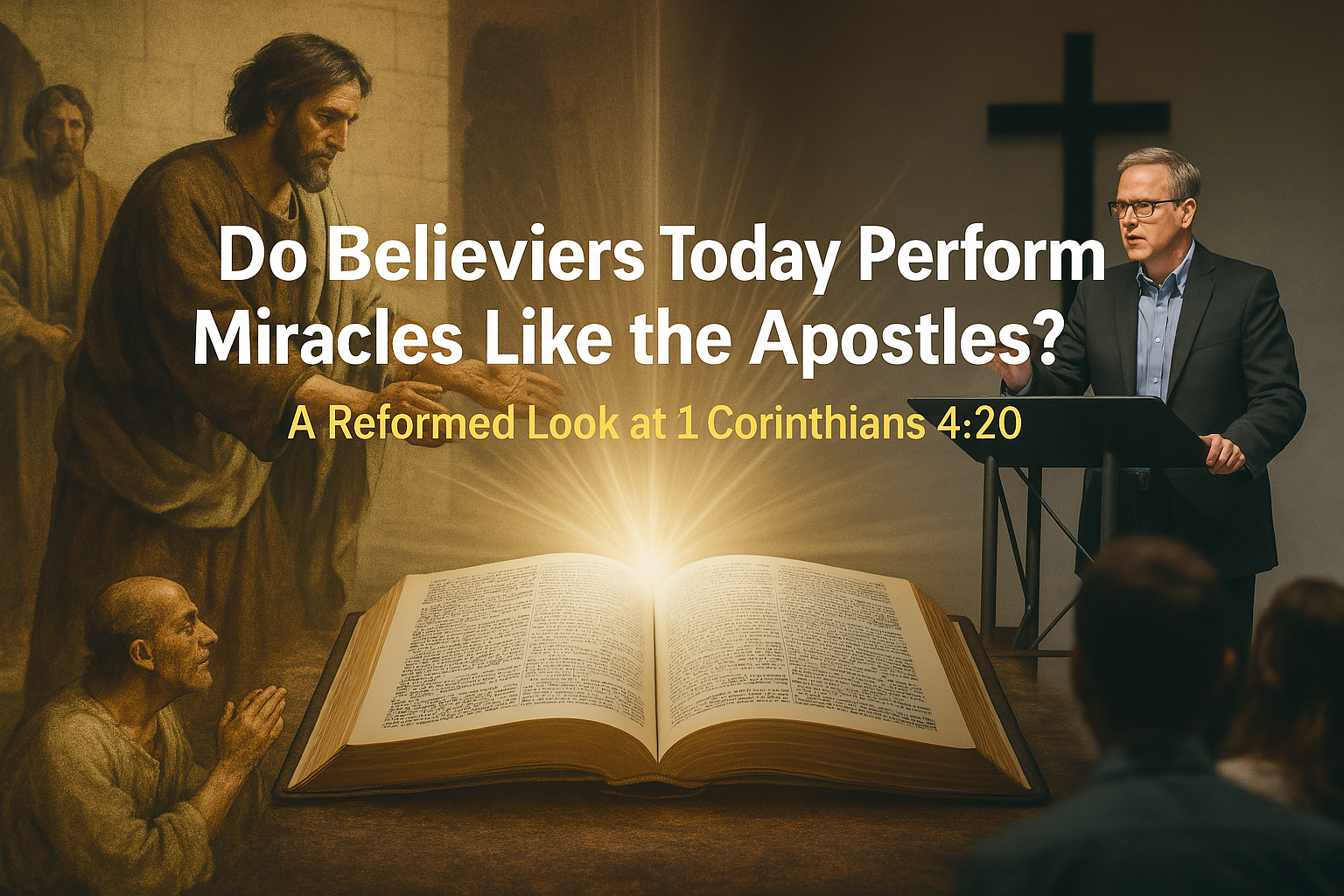
Do Believers Today Perform Miracles Like the Apostles? A Reformed Look at 1 Corinthians 4:20
Introduction
In an age of growing interest in signs and wonders, many Christians ask: “Can believers today perform miracles just like the apostles?” From healing the sick to raising the dead, these acts of power were undeniably present in the ministry of Christ and the early church. But what about now? Is the church still expected to function in such miraculous ways? Let’s explore the question through the lens of Reformed theology, grounding our answer in Scripture, especially 1 Corinthians 4:20, and the broader New Testament witness.
1. Power in the Kingdom: What Does 1 Corinthians 4:20 Mean?
Paul writes:
“For the kingdom of God does not consist in talk but in power.” (1 Corinthians 4:20, ESV)
The Greek word translated “power” is dunamis (δύναμις), often associated with supernatural strength or miraculous works. However, in this context, Paul contrasts mere rhetorical boasting with authentic spiritual authority — not just persuasive words, but Spirit-empowered gospel ministry that transforms lives.
Though dunamis can include miracles, Paul’s main point here is not about spectacular signs, but the genuine impact of the gospel — the fruit of the Spirit, holiness, and changed hearts.
2. Jesus’ Promise of Miracles: Mark 16 and John 14
Jesus indeed promised that miraculous signs would accompany the proclamation of the gospel:
“These signs will accompany those who believe: in my name they will cast out demons; they will speak in new tongues… they will lay their hands on the sick, and they will recover.” (Mark 16:17–18)
“Whoever believes in me will also do the works that I do; and greater works than these will he do…” (John 14:12)
These passages affirm that miraculous power accompanied the early preaching of the gospel. However, in the Reformed view, such signs served a specific redemptive-historical purpose: to confirm the message of Christ and His apostles during the foundational period of the church (cf. Heb. 2:3–4).
3. Paul’s Teaching: Some Gifts Will Cease
“Love never ends. But as for prophecies, they will pass away; as for tongues, they will cease; as for knowledge, it will pass away.” (1 Corinthians 13:8)
From a Reformed Cessationist perspective, this passage anticipates a time when certain sign gifts will no longer be necessary. While some argue that “the perfect” (v.10) refers to Christ’s return, others within the Reformed tradition understand it as referring to the completion of the canon of Scripture and the closing of the apostolic age — when the foundation of the church was laid (Eph. 2:20).
Thus, miraculous gifts were never meant to be normative, but temporary, tied to the unique ministry of the apostles.
4. Were All Believers Commanded to Perform Miracles?
“Are all apostles? Are all prophets? Are all teachers? Do all work miracles? Do all possess gifts of healing? Do all speak with tongues?” (1 Corinthians 12:29–30)
The implied answer is no. The Spirit distributes gifts as He wills (1 Cor. 12:11), and not every believer is called to perform miracles. The apostles were unique in redemptive history — witnesses of the resurrected Christ with authority to write Scripture and lay doctrinal foundations.
5. The Purpose of Miracles in the Apostolic Age
From a Reformed perspective, the miracles of Jesus and the apostles were signs that authenticated their divine message and office. Consider:
- Moses and Elijah had miracles to confirm covenantal revelation.
- Jesus performed signs to reveal His identity as the Son of God (John 20:30–31).
- The apostles did signs to confirm their unique role in laying the foundation of the church (2 Cor. 12:12).
As John Calvin stated: “We are not apostles, nor have we been called to lay the foundations of the Church. Therefore, we are not given the same signs.”
6. Does God Still Heal Today?
Yes, absolutely — God can and does still heal in response to prayer. Reformed theology is not anti-supernatural. What it rejects is the idea that all believers are guaranteed miraculous powers or that these should be expected as normative signs of spiritual maturity or salvation.
We pray in faith, but submit to God’s sovereign will, knowing that His grace is sufficient even in suffering (2 Cor. 12:9).
The main purpose of miracles was to point to the power of God to transform lives — to authenticate the gospel and call people to faith in Christ. But miracles are not the only means for transforming lives. In fact, the ordinary and most powerful means is the gospel message itself (Romans 1:16). Miracles may get attention, but only the Word of God changes hearts eternally.
Even Jesus, when asked to show a sign, rebuked the request by saying:
“An evil and adulterous generation seeks for a sign, but no sign will be given to it except the sign of the prophet Jonah.” (Matthew 12:39)
This highlights a vital truth: God’s ultimate sign is Christ Himself — His death and resurrection. People do not need more signs; they need the gospel. Today, we should not chase wonders, but faithfully proclaim the good news that has the true power to save (Rom. 1:16).
Conclusion: Power Without Presumption
1 Corinthians 4:20 reminds us that the kingdom of God is not just about words — it is about transforming power, but not necessarily in the form of miracles. That power is seen most clearly in:
- Changed hearts,
- Holiness,
- The preaching of Christ crucified (1 Cor. 1:18),
- And the ordinary means of grace — the Word, sacraments, and prayer.
While God may still choose to work miraculously, our confidence rests in the sufficiency of Scripture and the finished work of Christ. The power of the kingdom is not in signs and wonders, but in the Spirit-empowered proclamation of the gospel that brings dead sinners to life.
Soli Deo Gloria!
Written by: Pastor Ramil Engle
Reformed Teacher | Apologist | Bible Blogger


God is most certainly performing biblical-scale miracles now. I am a participant and witness to these events. I have collected a dozen written statements from the witnesses of the events surrounding them. My mother taught me to pray in secret, as God rewards in secret. Though I knew for so long, I hid myself. She saw the signs around me and warned me. People will think you’re lying, crazzy or worse. If they do believe you, they will try to make you into some sort of a science experiment. When I tried to tell the truth to my own church, they despised me and threatened me for it. People really don’t know that with faith, God does miracles. I suppose they don’t really believe what they say they believe. They must have thought that only perfect people have the spirit. It is very canacal that I confess the truth and be rejected by my community. I was threatened by “Christains” in front of my children for telling the truth.
Thank you for sharing your testimony and for taking the time to comment. I’m sorry to hear that you experienced rejection and harsh treatment from people who profess to be Christians. If those events happened as you described, no one should respond with threats or intimidation. Christians are called to speak the truth in love (Ephesians 4:15) and to test everything carefully (1 Thessalonians 5:21).
I certainly believe that God is still sovereign and is fully able to perform miracles today. Nothing in my article denies God’s power or His freedom to act supernaturally. God has not changed, and He still answers prayer according to His perfect will.
The question my article addresses is different: Has God given believers today the same miraculous, miracle-working office and sign-gifts that characterized the apostles? From a Reformed cessationist perspective, the answer is no. The miraculous signs performed by Christ and the apostles had a unique redemptive-historical purpose—to authenticate divine revelation and establish the foundation of the New Testament church (Hebrews 2:3–4; 2 Corinthians 12:12; Ephesians 2:20).
If God chooses to heal someone, intervene providentially, or perform an extraordinary work today, all glory belongs to Him. However, such events should never be used as evidence that a person possesses apostolic authority or ongoing sign gifts. Scripture repeatedly instructs believers to test every spiritual claim (1 John 4:1), because sincere experiences, however compelling, are not the final authority—God’s written Word is.
I appreciate your emphasis on faith. At the same time, biblical faith is faith in God’s promises, not faith in miraculous experiences. Our greatest assurance is not that we have witnessed extraordinary signs, but that Christ died for our sins, rose again, and that His gospel has the power to save all who believe (Romans 1:16).
Thank you again for your respectful comment. I pray that, above all, our confidence remains in Christ, the sufficiency of Scripture, and the gospel, which is God’s greatest display of power.